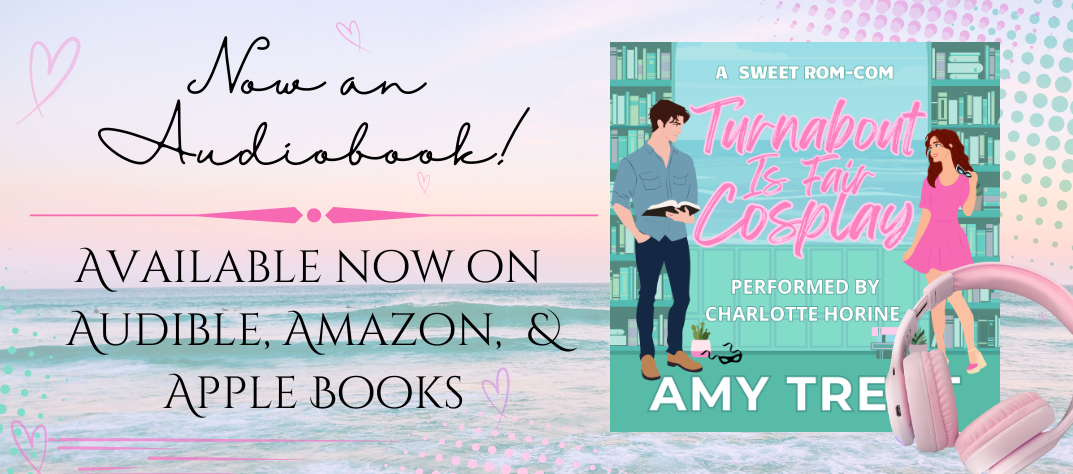
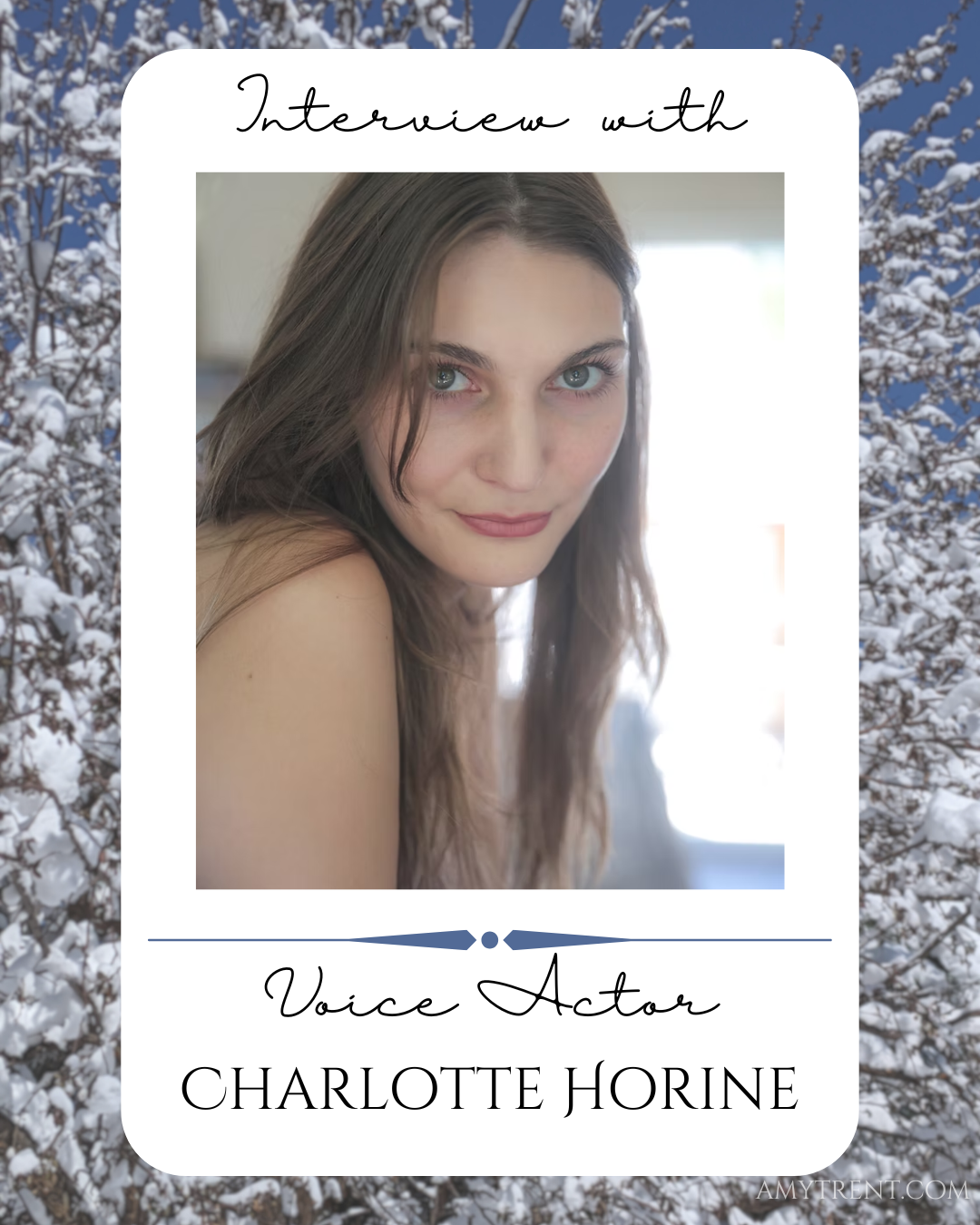
Charlotte Horine is a talented voice actor, phenomenal audiobook narrator, and passionate creator. I was lucky enough to hear a sample of her work late last year, and very quickly asked if she’d be willing to narrate the audiobook of Turnabout Is Fair Cosplay. Collaborating with Charlotte has been an absolute dream, and today she’s joining me on the blog for a chat about her craft and her passion for storytelling. I hope you enjoy.
Amy: Welcome, Charlotte! Thanks for joining me today!
Charlotte: Thank you, Amy! I feel very humbled by your introduction. It’s been an absolute joy working with you and voicing your characters.
Amy: I love audiobooks. I listen to them constantly, but this is a fairly recent development. Before my Hoopla account, audiobooks were relegated to the boxed CD sets I’d get from the library and pop into my car. As a voice actor, were audiobooks more on your radar from the get-go? Where are you with audiobooks now? Do you love them? Do they feel like homework? Are there things you can’t unsee/unhear as a pro?
Charlotte: The first time I listened to an Audiobook, I actually purchased it to help me get to sleep. I thought, ‘It will be like listening to a bedtime story,’ but the funny thing was, I became so interested that I needed to keep playing it back from where I had dozed off the day before because I was so keen on hearing it play out and felt connected to the characters. I hadn’t expected that because I had segmented audiobooks in a different camp than, say, my favorite movies or shows. It was a funny realization that somewhat baffles me now because it is an undeniable form of entertainment that had not been on my radar as something I would enjoy personally, despite being someone who has extensive movie, vinyl, and book collections.
I feel honored to be included in someone’s artistic expression and even more to be trusted with my own contributions. I wouldn’t say it feels like homework as much as a reasonable weight. I feel responsible to see out the vision of my employers and feel that I have given 100% of my efforts to each project. Unfortunately, that does hone an ear for certain things. I definitely can’t unhear certain sounds that I typically look for in an edit, even in everyday conversation, like a mouth click or sharp “S.” …stay hydrated, everyone.

Amy: Let’s get into it. How did you become a voice actor? What parts of your creative journey prepared you best for the work you do? What parts do you wish you could have avoided?
Charlotte: The question of Voice Acting first arose some years ago when I was with my then-boyfriend, now-fiancé, in his kitchen. He asked me if I had ever thought to explore voice acting, aptly citing my fascination with different accents, intonations, cadence, etc. and pointed out my not-so-very-secret habit of quietly mimicking characters to myself while watching movies together.
I was vocally-trained from the age of 6, performed in theater and dance my entire upbringing to then pair with this trained animator working in videogames, so together we consume a lot of media.
But it wasn’t a critique or something to potentially hide, it was an earnest question that I had never thought to answer before. And once it was out there, it just clicked into place. It felt like such a no-brainer.
From my experience acting on stage and in film, I know the same characters will always translate differently depending on the medium the audience receives them in, so my performance needs to be adapted in order for those characters to feel authentic, and it’s the same with voice acting. In order to prepare for this transition I studied Voice Acting at The Second City in Chicago, IL, which absolutely gave me the confidence to begin auditioning.
I wish I were impervious to that nasty little voice of comparison that gets us all. I know this is something that affects everyone regardless of field, but within my own realm as someone with creative ambitions, I think it is so easy to slip down that rabbithole. Luckily, the more I have grown into my own voice, the quieter that little one has become.
Amy: What are your influences? What are your sources of inspiration? Is there overlap between the two?
Charlotte: I love Hugh Bonneville’s narration in the Sherlock Holmes Short Stories podcast by the Noiser Network. He’s a fantastic actor to aspire to and as a listener, there’s an immediate understanding of the characters, their backgrounds, and temperaments, before their exposition really even begins.
To reference my media intake from before, I really do find inspiration from a hodgepodge of movies, animation, music, car commercials, you name it. While vocal types are often inspired by people I’ve crossed paths with in real life.

Amy: I’ve heard you’re no stranger to Shakespeare, which was of huge interest to me because of all the Shakespeare in Turnabout Is Fair Cosplay. What have been your favorite Shakespearean productions and roles?
Charlotte: I love a classic Shakespearean story! The first of his plays I attended was The Comedy of Errors, which remains my favorite to this day. My first of his roles, and as I say this, I know it to be a cliché, was in a high school production of A Midsummer Night’s Dream, in which I played Helena.
As an actor, I think it’s incredibly beneficial to study his works, if not for a masterclass in balancing wit and anguish, a deeper understanding of language and how it really can transcend time. I think a quick search of the incredible Andrew Scott’s performance of the To Be Or Not To Be Speech showcases this perfectly.
Amy: I’m fascinated by the process of creating. Everyone seems to approach their craft in different ways, from different angles. Would you share with us more about your process? Like are audiobooks read sequentially? Do you batch record one character’s dialogue?
Charlotte: For me, I definitely like to read through sequentially. I think it feels more natural as emotional ramp-ups take form so that every character I am “acting across” is on the same level and then I won’t need to check back in on the opposing tones that batch recording would require of me to do more frequently.
Amy: Dialogue is my favorite to both write and read. As an author I work hard to make sure that the dialogue I write is distinct for each character, but that boils down largely to diction and sentence structure. How do you keep the voices of different characters consistent when you’re narrating?
Charlotte: As I am reading through and happen upon a new character, I have a little process that best works for me for this purpose. I see a new name and take a beat. Do a little digging into their background and motivations. That already starts to inform me of the vocal type beyond the descriptions that I am given to work with, and I workshop until something “fits” them. I then assign a keyphrase for that character in their voice. Typically, it’s the first line of theirs, and I use it as a way to call back on them the next time they pop up in story, so I have a way to jump right back into their character for continued dialogue.
Amy: It’s winter, and it’s been an incredibly snowy one for some of us. Routines have been as unpredictable as the snowfall. How does your process change with the seasons?
Charlotte: I am already a perpetually chilly person and the winter really does drive that home. I am definitely guilty of bringing heating pads into my recording sessions and certainly sipping a hot cocoa while I edit. Shout out to Dandies Marshmallows. When I get too cold, I get sleepy so in a way, I think the cocoa is really performing a valuable service…with the occasional vitamin D supplement.

Amy: As a writer I’ve benefited and continue to benefit from critique, editing, and outside perspectives. Multiple edits, outside perspectives, and revisions are part of the writing process, but words are (in theory) easy to edit/change/rewrite. How does critique work when it comes to acting? Is revision part of the process?
Charlotte: Oh, without a doubt. Like any artist, I remain my biggest critic and with voice acting in particular, I will disassociate from the voices that I am listening to while I edit and take on a role of director instead. Sometimes a voice that I think is totally killing it in the recording doesn’t sound right once it’s played back. Maybe their too excitable or their voice should have had or more melodic quality that I missed; it’s all part of the process and gets easier the further in.
Outside feedback is gold. Part of being an actor is being malleable and leaving any ego at the door because it’s about how the audience receives that voice. So being able to collaborate and adapt to the feedback quickly to find that right sound is an absolutely amazing feeling.
Amy: I saw on your website that you have some original short stories in the works. Very exciting! What motivates you to create?
Charlotte: You’re a sleuth! I love to create. In a way this is a difficult question to answer because I don’t fully know where the motivation comes from other than the fact that the need to be and express my creativity has always been there. I am a performer but I do also love to write and draw and create recipes in my kitchen. …For me, creating is both an incredibly empowering and humbling experience because I do feel this launch of confidence and pride in what I produce that is immediately followed by an insatiable desire to keep progressing in my development as an artist. What is lovely about it is that there doesn’t need to be a fear of failure, because the journey is in your own hands as a creator.

Amy: What do you wish more people knew about voice acting and your work?
Charlotte: That AI is not an aide that voice actors are looking for and not the harmless contractor that some people believe it to be.
In a sense, I think it’s wonderful when listeners can completely forget that there is an actor behind the mic and are able to fully immerse themselves in the characters or voices they are listening to. In my mind, that’s a successful job. At the same time, I think it’s important to remember that those performances are worthwhile because of the fact that they did come from an actor that has honed their craft and can add depth to the project at hand.
Amy: Cookies are my favorite. I love eating them. I also love writing about them. Do you have a favorite cookie?
Charlotte: Mmm, this is an excellent question. I have a very demanding sweet tooth and cookies are no exception. I’m vegan so I have learned to bake over the years and have cracked the code on my own favorite, my bourbon-brown sugar-vanilla- butter chocolate chip cookies with sea salt flakes….I know that’s a mouthful, but it’s a good one.
Amy: Thank you so much, Charlotte! I’ve loved learning more about your process and passion. Where can everyone find you if they want more playful, immersive, professional storytelling and art in their life?
Charlotte: Thank you, Amy! I appreciate you and if anyone out there wants to keep up with me, they can find me on instagram @charlotte.marisa.horine or my website at charlottehorine.com