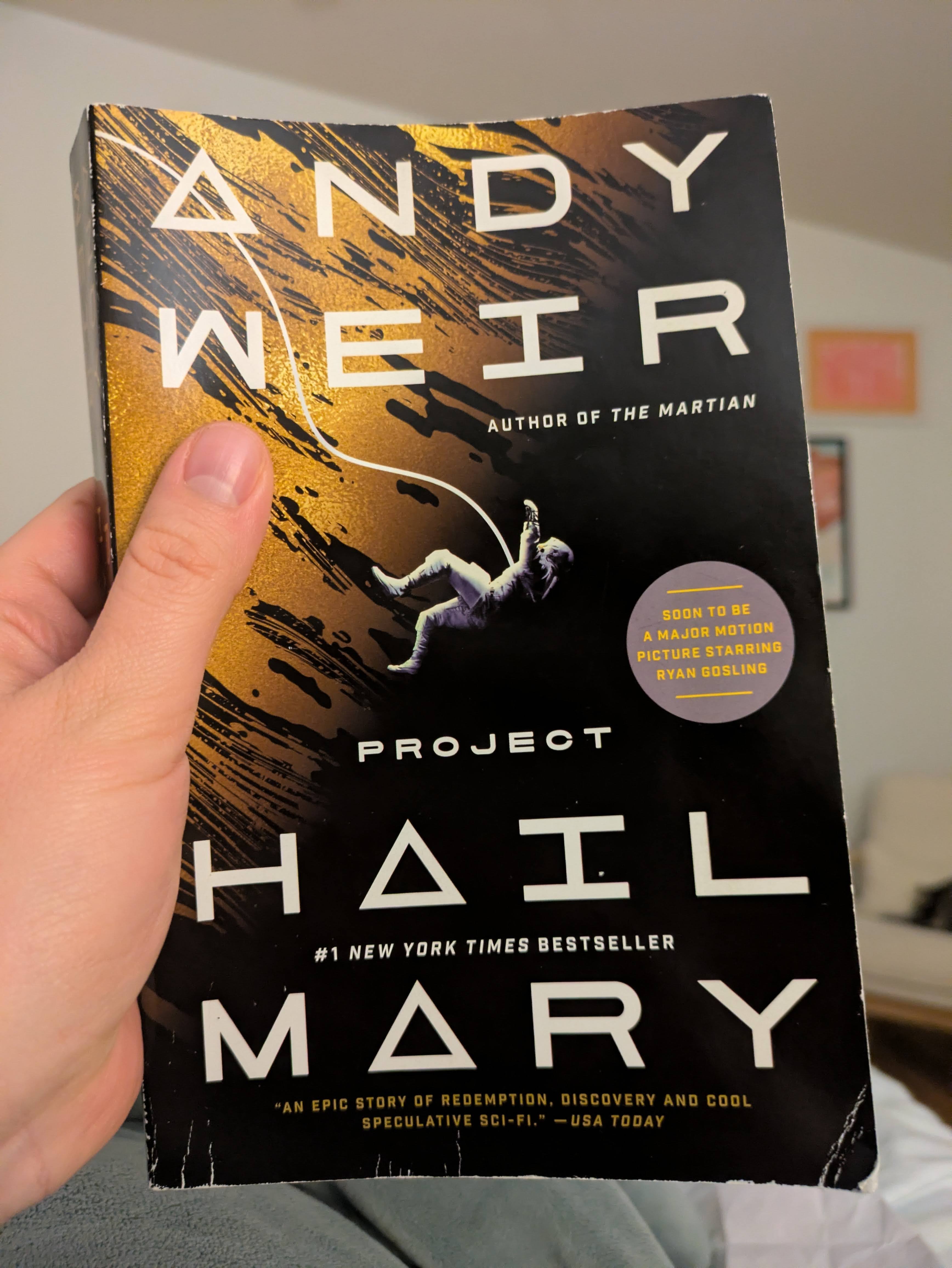
This last week I read and thoroughly enjoyed Project Hail Mary by Andy Weir. I fully believe that friendship and a good science teacher could save the world. In fact, I’ve had a science teacher who I’d absolutely recruit for the job. The novel was all the sci-fi fun and feel-good joy of Star Trek plus the audiobook (I started with paperback, switched to audio for a long commute I had on Wednesday, and finished in paperback) was so good (hats off to Ray Porter–his accents were amazing).
Andy Weir does a lot of clever, fun things in this book. One that I enjoyed was his use of non-crude profanity. If you haven’t yet read the book or want to go into the movie completely blind, skip this next part of the post because there are spoilers ahead. Weir’s main character, Ryland Grace, has amnesia and doesn’t know who he is or what he is doing on a space ship at the start of the novel. But he is curious, inquisitive, and data driven. So he picks up on his interesting use of non-crude profanity from the very first chapter.

His observations continue.

Our main character, who doesn’t even remember his own name at this point in the book, infers aspects of his past and present self from this use of non-crude profanity and the reader does too. Ryland Grace is a quirky, endearing guy who sanitizes his swears for reasons both he and the reader don’t yet understand. And this element creates a bit of levity and humor to balance the fairly grim situation the character finds himself in at the start of the novel. The non-crude profanity is funny. It’s memorable. It adds another piece of data to the puzzle.
That is not to say there is zero profanity in this book (read it before you give it to your teens), but there wasn’t much. And when Ryland Grace drops the one and only actual f-bomb in the story, profanity does what it is supposed to do. It emphasizes the moment and conveys just how earth-shattering the event is. Ryland Grace sanitizes his swears, except when he is so shocked that he can’t.
Last September I taught a workshop at Rocky Mountain Fiction Writers 2025 Colorado Gold Writers Conference about profanity, specifically non-crude profanity. It was a fudging good time, even if I was a ball of nerves and sprinted through my slides. Being introverted is a party a minute. When I was preparing for my workshop, I did quite a bit of research that confirmed what we all have experienced when it comes to profanity. Frequency matters. Swears of any ilk lose their potency the more they are used. Profanity must be used sparingly, like a garnish. What is sparingly? Well, it depends on the medium, genre, and audience.
Profanity is highly individualistic. It’s cultural too. In Portuguese the word “our” (nossa) can be used as an exclamation that means “wow.” This word is considered uncouth by some because it is part of the minced oath Nossa Senhora, which translates to “Our Lady” with the lady in question being the same Mary that is referenced in the title of Andy Weir’s latest novel. Some people feel “Nossa” is profane. Other people aren’t bothered, and to them “Nossa” just means “wow!” I asked my French tutor, once upon a time, about the expression Oh la vache! (literal translation: “Oh, the cow!”). I’d watch a French rom-com, and it was the only expression I understood. Could I say this on the streets of Paris? She shrugged her shoulders and told me some people would think it’s “cute” while other people might be offended.

I write no-spice romance which depending on who you talk to is part of the “clean” reader world. These readers often have expectations regarding language. Take Instagram influencer Rachel Parker @closeddoorromance, for example. She uses the following scale where both type of profanity and frequency of use are considered.

Other groups are concerned with type of profanity only and do not track frequency of use. Why use any profanity at all if it will alienate some readers from the get-go?
The conclusions I came to in preparing for my workshop are that profanity is human and profanity communicates a whole lot about humanity. Every human uses language to convey emotion. While the sentences that I am composing now are controlled by my left brain (the side that can process data and retrieve words), profanity is a function of my right brain (the side that is responsible for emotion, creativity, and feeling). Check out this paper I came across from Brain Research Reviews. TLDR: increased use of swearwords is common across many instances where speech/language is inhibited.

And check out this article from Time Magazine, which I summarized in the graphic below.

Profanity, crude or non-crude, is expressive. Certain sounds and combinations like the forced air stops or the bared teeth, hissing/growling fricatives are expressive and frankly primitive. They say, “I’m angry and the words I’m saying are explosive and stop abruptly and require me to making hissing and/or growling sounds and you see my teeth flash threateningly when I’m saying these words.” It’s a bit of onomatopoeia coded into our language. I like this quote from my impressive sister who began every semester of her college freshman English classes with an overview of the history of the English language. “English is generally acknowledged as a top notch swearing language.”
Profanity is human; we all do it. Most of the sanitized swears we use go back to blasphemy, zounds, zowie, omg. Most of us aren’t concerned with the etymology of a phrase when we stub our toe. We just need to reach for something to help us express ourselves in that moment. And the moment isn’t earth shattering–so we reach for a non-crude swear.
By the way, did you know there are three different use cases when it comes to profanity? Cursing, swearing, and oaths are all distinct uses. Darn you, darn it, and by darn–amazing how versitle swears can be. Shakespeare is repleate with examples of cursing, swearing, and oaths.
Shakespeare loved language. In his works are the first written instances of many many words that we take for granted today. I believe he invented these words (it just makes sense that a wordsmith of his talent would start smelting and creating different names for things), but he loved to play with language. So it is little wonder that we see all kinds of clever examples of cursing, swearing, and oaths in his works.
Some examples I shared from my workshop of Shakespeare’s oaths, curses, and swears.


Authors reach for non-crude profanity too, and the result is deeper world building and more expansive character development. In Project Hail Mary we get some clues about who Ryland Grace is from his non-crude swears that fall into place when we learn that he is a middle school science teacher. Yes, adults who work with young minds would get in the habit of using non-crude profanity to express themselves.
Another example I used from my workshop was Annie Wilkes from Misery by Stephen King. A grown woman who has no qualms with about being a serial killer but whose moral compass demands she never use a four-letter word? She’s an absolutely chilling unstable character. Also chilling is how the MC begins to adopt her words towards the end of the narrative. Tyranny of the mind is at work.
Brandon Sanderson deploys non-crude profanity as a means of world building. Furthermore, he invites his readers to be become part of the story. Language can identify us and signal that we are part of the group. If I’m at the SLC airport on my way to Dragonsteel Nexus and hear someone say “storming!” or “rust and ruin!” at baggage claim, I’m absolutely going to drop a “mother’s milk in a cup, am I right?” and strike up a conversation about the upcoming conference.
Interestingly, I was on a panel about non-crude profanity at the 2025 LTUE Symposium, and the room groaned when our panel’s moderator asked how everyone felt about “storming,” suggesting to me that it’d become a little overused in the cosmere. I shared this quote from Grace Burrowes in my workshop last September.

“Storming” is an immensely clever and effective non-crude swear, but it isn’t immune to losing some of its sparkle with overuse.
Apart from character and world building, sometimes authors use non-crude profanity because it allows them to safely explore important topics and stories without alienating their audience. A notable example being Kimberly Brubaker Bradley’s award-winning, middle-grade novel Fighting Words.

This novel would not exist in the middle grade world without the creative use of non-crude swears, and it would absolutely struggle to reach a wider audience without them. And as an aside, I excitedly recommended Project Hail Mary to my thirteen-year-old son after reading it. Would I have done that if all the sanitized swears and non-crude profanity in the book were explicit? I don’t think so. He stayed up until 1AM last night reading it. He’s halfway through it and told me this morning, “It’s a really good book.”
Profanity–non-crude or run-of-the-mill– is profoundly human. It’s taboo. Some of it is still illegal in several US states. It’s emotional. It’s right brain. It’s stylistic. It’s cliche. It tells us a lot about a character, a world, a moment. It can unite us or divide us. Slurs, for example, are a type of profanity I cannot stomach and as such my workshop didn’t engage with them.
Using any type of profanity in our written or verbal expression requires responsibility. And yes I think Spiderman’s “With great power comes great responsibility” applies here. We can use profanity in creative ways. It’s a tool that we each wield uniquely. I liked how Benjamin K. Bergen put it in his book What the F.

Profanity, even non-crude profanity is a monster, and caution and careful handling are necessary when it comes to monsters. But also… Monsters can be a lot of fun for writers and readers.
If you by chance attended my workshop, and would like a copy of my slide deck, please reach out. I’m happy to send you the PDF. If you have some excellent examples of non-crude profanity in fiction, tell me about them! I’ve gotten into the habit of collecting them.